Funds held by a smart contract or sent to the wrong place: what can realistically be done
Status: Published: Last reviewed: Editorial policy
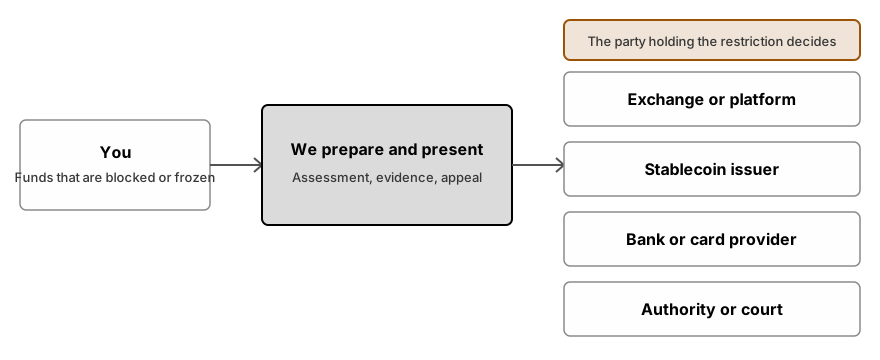
A confirmed blockchain transfer cannot be reversed by anyone. Funds return only if a party holding control agrees to act: a protocol team with an admin function, an exchange that owns the receiving address, or a wallet owner. We check the options, contact that party and document the case.
Need a case detail checked? Send it here:
What we do
- Determine the on-chain record of the transfer
You and TraceStolenCrypto read the transaction on a block explorer. We check the sender, receiver, network, token, contract and status. If a case appears lost, the cause may be a pending transaction, a different chain or an exchange-controlled address.
- Identify the destination controller, if one exists
Review the receiving address type: wallet, exchange deposit, or smart contract. This check determines if any possible recovery route exists.
- Contract Review with Independent Specialists
Independent engineers analyze the code and permissions: admin keys, pause functions, and timelocks. They document if a return path exists and identifies the controlling party.
- Written Contact with Relevant Party
We prepare a concise communication for the protocol team, exchange support, or address owner. It includes required hashes and addresses via official channels.
- Claims and Legal Coordination
If the counterparty is identifiable and the value warrants action, independent counsel can advise on a demand letter or claim. We help file claims against protocol compensation plans using holding evidence.
How a case runs
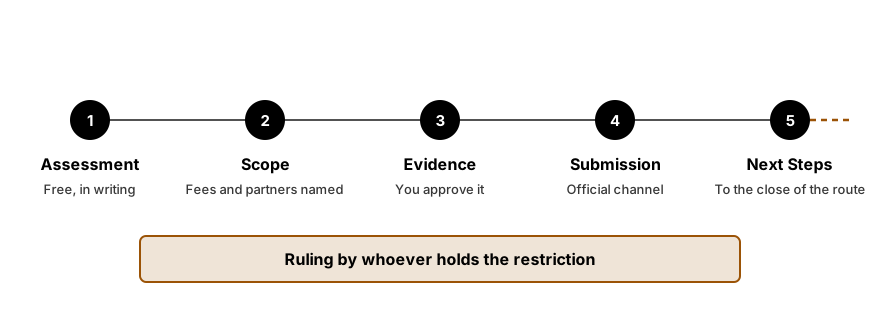
- Free initial review
Input the transaction hashes, network designation, and expected outcome details. We provide a written reply confirming if any recovery path is possible or if the funds are final.
- Scope in writing, plus fee
If recovery action is feasible, we send the scope, specialists, and fee model for review. Otherwise, we conclude the matter at no cost.
- On-Chain and Contract Analysis
Step one is a trace: we map the transfer on-chain, then specialists examine the contract code and the permissions it grants. The output is a plain summary stating which parties can act on the funds and which cannot.
- Contact and claim
We deliver a written approach to the party holding control and log each response as it arrives. You receive copies of every message we send and every reply we get.
- Outcome record
The file closes with a brief written record of the steps attempted and their result. If no route remains, we state that plainly and close the case rather than leave it open.
Inputs to prepare
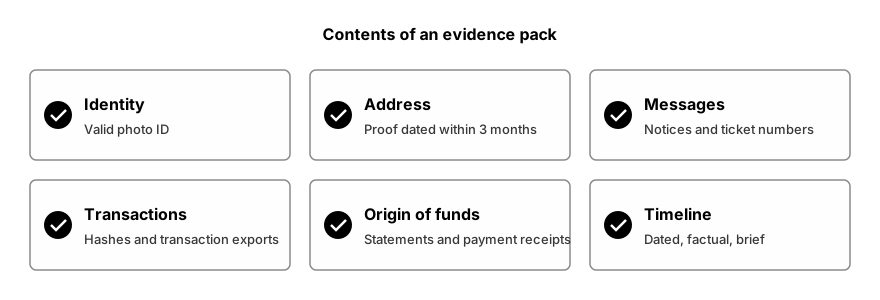
- Transaction hashes for each transfer, labeled with the network used
- The address of the sending wallet, plus the receiving address or contract address
- Images captured from the app, site or exchange display at the moment the fault showed up
- The token's name, the address of its contract, and the official documentation or site
- Correspondence with support staff, project channels or the receiving party, where it exists
- Evidence that the sending account is yours, for example an exchange statement. Never send a seed phrase or a key.
- A brief timeline: what you meant to do, then what actually happened, in order.
What we cannot do
- Once a transfer is confirmed on-chain, its state is fixed. No one, including us, can reverse, cancel or alter that record.
- In most cases the outcome depends on three parties: a protocol team, an exchange, or the receiving party. We do not control any of them, cannot force their hand, and each one decides on its own whether to assist.
- We do not promise a return. If the honest assessment is that the funds are gone, we state that early, before you spend more.
- We never exploit bugs, attack contracts or extract funds from contracts you do not own. Doing so is illegal in many jurisdictions and would damage your case.
- All inputs come from public on-chain data. We therefore never ask for a seed phrase, a private key or a password.
Common situations
- Sending tokens to an address that is valid on a different blockchain, but the transfer used the incorrect network.
- Cryptocurrency transferred to a token's contract address rather than a wallet address.
- Check staking and vesting contracts that stop releasing tokens after an upgrade or a pause
- A protocol exploit drained the pool holding your deposit
- A mistyped address or one resembling the intended one, where the recipient proves to be a real wallet held by a stranger
- A transaction that failed yet still consumed the fee, leaving the location of the assets unclear
- A deposit sent to an exchange address that does not list the token you sent
This fits your case if
- Tokens left your wallet and arrived at an incorrect address, an unsupported network, or the token contract itself
- A smart contract, meaning code that holds funds under fixed rules, is keeping you from withdrawing
- A protocol bug or exploit hit your deposit and the team has communicated little
- Users of your small project lost funds because of a defect in your contract
- Decide with a candid answer about whether funds can return, before paying for anything further
How long it takes
The on-chain check runs fast once you supply the transaction hashes. Every later step depends on the other side: a protocol team, an exchange or an address owner may answer in days, in months or never. We report each reply as it arrives.
Fees
A preliminary assessment, provided free of charge, establishes if any recovery route exists. If progress proceeds, scope and fee models are documented before payment. Independent specialist contract reviews are itemized to permit cessation at any stage. Fees →
Questions people ask
If I sent crypto to the wrong address, can it be recovered?
Recovery works only if whoever holds control of that address agrees to return the funds. A confirmed transfer on the network has no reversal mechanism. If an exchange controls the address, its support team may assist. If the address is a private wallet with an unknown owner, there is normally no route available.
I transferred tokens over the wrong network. Are they gone for good?
The outcome depends on who controls the destination address on that network. If the address exists there and belongs to an exchange or wallet provider, that party may recover the funds, sometimes charging a fee for it. If no party controls that address on that network, the funds are usually unrecoverable.
What happens if I sent tokens to the contract address of the token itself?
Retrieval here is difficult. Most token contracts contain no function that releases tokens sent in error, so the balance remains at that address. Some projects include a rescue function or can act through governance, so two checks are worthwhile: read the contract code and contact the project team.
Could a developer patch the bug and send my funds back?
In some cases yes. If the contract is upgradeable or contains a pause or rescue function, then the team holding those keys may be able to act, and certain protocols operate compensation plans after an exploit. A contract that cannot be modified cannot be fixed by anyone.
Can you hack the contract to extract my funds?
No. Exploitation of a contract constitutes an illegality across multiple jurisdictions and risks additional losses. Services offering this method typically present scammer characteristics. We employ only lawful procedures: code reading, communication with the proper entity, and engagement with an independent lawyer when deemed appropriate.
Do you require my seed phrase in order to inspect my wallet?
No. The work relies only on public records: hashes and addresses. A legitimate specialist has no need for your seed phrase or private key. If anyone requests them, stop; treat that request as a scam.
Related situations
- DeFi exploit and bridge hack: response runbook. Tracing, alerts and reporting after an exploit, bridge hack or malicious approval.
- Blockchain analysis report. A source-of-funds report built by tracing transactions, formatted for a compliance team.
- Tracing stolen crypto, sending freeze requests. Tracing, freeze requests to exchanges and issuers, and police report support.
Read next
Sources
This record is derived from external, primary sources. Validation depends on the source documentation. Changes occur; review the originating platform for current content.
- Introduction to smart contracts · ethereum.org
- Upgrading smart contracts · ethereum.org
The content on this page is general. It is not legal advice.