
Can stolen crypto be frozen? Where freezing works and where it fails
Status: Published: Last reviewed: Editorial policy
Sometimes. A freeze works only at a control point: funds held on an exchange account, or a stablecoin like USDT or USDC, whose issuer can block a listed address. Bitcoin or Ether sitting in a self-custody wallet stays under the holder's control alone, so nobody else can lock it. Movement often happens within hours, which makes a fast, well-documented report the input that matters. It raises the odds; it does not make the outcome certain.
Need a case detail checked? Send it here:
A freeze needs a party that can refuse
No crypto network has a central desk that reverses payments. A freeze happens only when a company holding the funds, or controlling the token, decides to block them.
So the real question is not whether crypto can be frozen at all. It is where the stolen funds sit at this moment, and whether a company at that point has both the power and the intent to act.
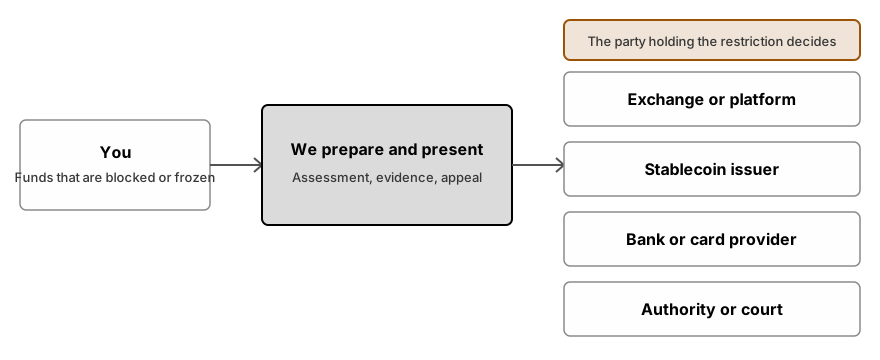
Where a freeze is achievable
Two main situations make a freeze genuinely possible. In each, someone other than the thief holds a lever.
- An exchange account: when the thief moves the funds to a regulated exchange, that exchange holds the controls and can restrict the account during its review of a credible report.
- A stablecoin with an issuer freeze: certain issuers can blacklist an address, which stops the tokens at that address from moving.
- A payment service or broker used by the thief to cash out, if a report reaches it in time and its compliance team reads the report.
- The final stop of a payment chain: a bank account, where that bank may hold back or reverse a payment according to its own internal rules.
Where a freeze cannot happen
Coins native to a chain, such as Bitcoin or Ether, sitting in a wallet controlled by the thief cannot be frozen. No exchange, issuer or court can block a private key stored on someone's own device.
If funds stay in a wallet of this kind, the only realistic route is to trace them until they reach a service that holds a control point. This can take days or weeks, and it may never happen.
If funds pass through a mixer, a cross-chain bridge, or a run of newly created wallets, tracing becomes harder. Harder still does not mean impossible. It means expect gaps in the record.
Why speed matters so much
A thief who intends to cash out typically moves the funds several times within a short window. Every hop lengthens the trail and puts the parties who could act further away.
The probability of intervention increases if the report reaches the exchange while funds are within an account. Exchanges require specific data to operate: transaction hashes, addresses, timing, and factual narratives.
A swift report functions as a request, not a mandate. The issuer or platform determines if action is required, frequently necessitating a police report or a specific legal order to freeze assets.
Initial Procedure: Steps to Execute
Maintain record clarity and process simplicity. Do not attempt asset recovery independently, nor pay any entity promising a rapid reversal.
- Document transaction hashes, wallet addresses, amounts, and precise timing for every transfer that originated from the wallet.
- Capture images of all involved messages, websites, and profiles before such data becomes unavailable.
- Notify law enforcement and the specific platform of the theft, retaining all issued reference numbers.
- Transfer remaining funds to a newly generated wallet created on a device verified as secure, assuming control persists.
- Never disclose your seed phrase, private key, or password to any individual, regardless of the recovery offer made.
Projected Constraints and Subsequence Actions
Outcomes vary: some cases end in a partial freeze, some produce nothing, and many run for months. A freeze also does not equal recovery. Locked funds typically remain under the control of the exchange, issuer or court until that party decides their fate.
Assessment of your case is free. Working with independent specialists, we trace where the funds moved, assemble a clear evidence pack and draft the reports. We hold no power to compel any exchange or issuer, and no outcome is promised.
Frequently asked questions
Can stolen Bitcoin be frozen?
No freeze is possible as long as the stolen crypto remains in a wallet owned by the thief. Bitcoin lacks a central issuer or control point. Freezing can happen only after the assets enter a service, like an exchange, that voluntarily restricts an account.
After a theft, can Tether or USDC still be frozen?
Technically, often yes: the issuers of these stablecoins can block a specific address. Whether they act depends on their own rules, the evidence supplied and, frequently, a police or legal request. No freeze happens automatically.
What temporal constraint defines the required input for reporting a theft?
Speed is the controlling factor: move fast. Stolen funds typically change wallets within hours of the theft. A short report that contains the transaction hashes and arrives the same day outperforms a longer account submitted a week later. Send the minimum factual record first, then add detail as you collect it.
Does freezing the assets mean I recover them?
A freeze is not automatic. It blocks movement only. Release to the victim requires proof of ownership, often a legal order. The process may take a long time.
Does filing a police report change the outcome?
Possibly, and often yes. A report with a reference number from law enforcement functions as a trigger: exchanges and issuers tend to process such cases faster, and some systems will not open an action at all without that number. Record the number, then provide it in every contact with them.
How we can help
- Tracing stolen crypto, sending freeze requests. Tracing, freeze requests to exchanges and issuers, and police report support.
- Blockchain analysis report. A source-of-funds report built by tracing transactions, formatted for a compliance team.
- Appealing a stablecoin issuer freeze. Evidence-backed appeal for a freeze by Tether, Circle or a comparable issuer.
- When authorities freeze your crypto. When authorities hold your crypto, we arrange independent licensed lawyers. We give no legal advice.
The content on this page is general. It is not legal advice.