
Address poisoning and wallet drainers: operation mechanism, detection method, post-loss procedure.
Status: Published: Last reviewed: Editorial policy
Address poisoning and wallet drainers are two ways to lose crypto without any break-in. Poisoning: a stranger inserts a lookalike address into your history and waits for you to copy it. A drainer: a fake site gets your signature on a permission, then the attacker moves your tokens later. Verify full addresses, read every signing request, and revoke approvals you no longer need. Once funds are gone, speed matters, but no return can be promised.
Need a case detail checked? Send it here:
Two different tricks with one shared cause
Both attack paths rely on an action performed by you, the account holder. No hack of your wallet occurs in either case. Address poisoning causes a transfer to a wrong address; a wallet drainer gets a permission signed that was not understood.
A hardware wallet or a strong password blocks neither attack, and here is the mechanism: the wallet executes whatever the signer approves. Your control sits at two checkpoints, so treat them as such. First checkpoint: copy the recipient address. Second checkpoint: approve each signature request. Slow down at both.
How address poisoning works
The mechanism: an attacker monitors the chain for wallets with frequent outgoing transfers. They generate an address whose first and last characters match one of your regular addresses, then insert it into your transaction history. Method one: a small deposit is sent to you from the lookalike address. Method two: a zero-value token transfer is triggered, which produces a record that reads as if you paid the lookalike yourself.
Later you need to pay the same recipient a second time. You open your transaction history, copy the entry that appears correct, and confirm the send. Because many wallets display only the first and last characters, and those characters match, the error slips through easily. Once a transfer is confirmed on-chain, it cannot be undone.
No hack occurred, and your keys remain secure. The failure point is relying on the history list. Copy the address from a saved contact or get it from the recipient, verify the entire string, and if the sum is large, send a small test amount first.
How token approvals and wallet drainers operate
A token approval is a permission granted to a smart contract, letting it move one type of token out of your wallet. Trading and lending apps require it so they can execute when you press a button. That part is normal. The risk: the permission stays active after you leave the site, and it is frequently set to unlimited.
A wallet drainer is a malicious kit that a scammer embeds in a counterfeit site, a counterfeit airdrop or a compromised page. The mechanism has two steps: first the page requests a wallet connection, then it requests a signature. The signature may take three forms: an approval, a signed message that functions as permission, or a transfer executed directly. If any of these grants permission, the attacker gains control over your tokens and can move them later, sometimes weeks afterward. Disconnecting the site does not revoke the permission; the grant stays on the blockchain until you cancel it or it expires.
Review request verbs like approve, permit, or set approval to determine if control over tokens transfers to another party. A signed message requires no monetary fee.
| Pattern | Your action | Appearance | Does a revoke help? |
|---|---|---|---|
| Address Poisoning | Transmit crypto units to an address similar to previous transaction records. | If a minor transfer originates from a visually similar address, the attacker initiates a standard transfer. | No. The transaction finality is established, and authority to revoke does not exist. |
| Token Approval Drain | You signed an approve or set-approval-for-all request | Clicking a claim, verify, or mint button on a fraudulent site triggers a wallet permission request. | Yes. Revocation prevents future asset extraction, but it does not revert previous actions. |
| Signed-Message Drain | Signing a transaction message grants authority, frequently requiring zero payment. | A 'sign to continue' prompt with no cost attached | Execution may fail to demonstrate the permission until the attacker employs it. Transition assets to a new address if this condition occurs. |
| Seed phrase stolen | Input of seed phrase data to unauthorized pages, applications, or support personnel. | Forms labeled "validate your wallet" or chat prompts requesting recovery words present a critical risk. | The attacker maintains key control and performs signatures in your name. Relocate residual funds to a different wallet immediately. |
Identifying Indicators Prior to Transaction Execution or Asset Transfer.
Assets are often compromised quickly following high-pressure notifications demanding immediate response. Utilize this list as a verification constraint to pause execution.
- Unsolicited tokens, NFTs, or small transfers constitute a risk indicator. Do not execute swaps, sales, or engage with associated hyperlinks.
- Access application software using self-maintained bookmarks. Avoid exposure via advertisements, direct message content, or embedded reply links.
- Monitor the state displayed within the digital wallet interface. If a login or claim requests token approval, identify the reason.
- Prohibit infinite token approvals. Adjust the transaction amount input field to precisely match the necessary trade volume.
- Verify the complete address string, not merely the initial or terminal characters. Utilize saved contacts when sending funds to frequent recipients.
- Maintain principal savings within a wallet that remains offline. Deploy a secondary wallet possessing a limited balance for new application interactions.
- When using a hardware wallet, compare all displayed details across the device and the computer screen. Cease execution immediately if any variances occur.
General Principles for Approval Revocation
Revoking functionality utilizes a new transaction to return a specific permission to zero. This reset applies to one token and one specific application. A network fee incurs this operation. The process is effective only for permissions recorded upon the blockchain.
Examine the permissions screen within the wallet environment. Various block explorers supply token approval verification. Independent tools are also available for review. Access these methods by manually entering the address string. Avoid links found in message content. Many platforms permit address lookups without wallet connection.
Revocation terminates future asset withdrawals. It cannot return funds that have previously exited the address. If the attacker possesses the seed phrase or private key, revocation fails because they can sign authorizations. Establish a new wallet using a separate device and transfer remaining assets.
- Catalogue all active approvals for each address, segregating verification by network.
- Terminate unrecognized permissions and revoke any unbounded permissions no longer utilized.
- Initiate payments using your own wallet funds. Reject any party offering to perform revocation on your behalf.
- Execute this verification process periodically, or following any signing event that exhibits unusual characteristics.
Protocol for addressing unauthorized transfers or fund depletion events.
Cease signing further transactions and terminate the originating website, but capture its address. Utilize a block explorer to trace the fund transfer, then identify preceding approvals or messages.
- Record the transaction hashes, participating addresses, network identifier, respective amounts, and associated timestamps.
- Archive the site address, the specific advertising material or message which triggered the incident, and all chat correspondence.
- If private keys are potentially compromised, transfer remaining assets to a new wallet on a clean device. Otherwise, first revoke all open approvals.
- If funds reach a regulated exchange, notify that exchange. Report to police or the national cybercrime service, keeping the reference number.
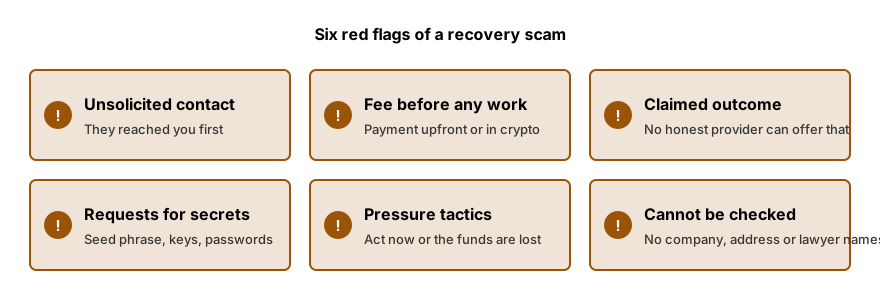
- Do not act on anyone who says they can undo the transaction or hack the attacker back. That offer is the follow-up scam.
What can return, and when to request help
On-chain transfers have no undo function, so most losses stay lost. A limited set of cases has a usable window. The funds may land on an exchange or with a stablecoin issuer, each of which can freeze them at its own discretion, or the holder of the wrong address may choose to return them. Fast action and a clean log of the hashes improve the odds, but no outcome is certain.
We cover the steps inside that window. Independent analysts trace the movement, we assemble the evidence, and we draft the freeze requests and reports. We cannot reverse a transaction or compel anyone to send funds back. The first assessment costs nothing, and fees are discussed only after we state whether help is possible. Tracing relies on public blockchain data, so no one on our side ever needs your seed phrase, private keys or passwords.
Frequently asked questions
If I disconnect my wallet from a site, does that revoke the approval I already granted?
No. Disconnecting ends only the session between the site and your wallet. A token approval is a record on the blockchain and remains active until you revoke it. After any suspicious request, review your approvals and revoke each one you do not recognise.
If funds were sent to a poisoned address, is recovery possible?
In most cases, no. Once funds leave your wallet, the transaction is final and the attacker holds control over that address. Recovery is possible only when the address belongs to a service, for example an exchange, and that service agrees to intervene. If you act fast and submit the transaction hashes, the odds improve slightly. Treat anyone claiming they can reverse the transfer as a warning sign.
Is revoking an approval a paid step?
Yes. A revoke is itself a transaction, so a network fee applies and it rises and falls with demand. Submit it from your own wallet. No third party must be paid to do this step, so treat any paid revoke offer as a red flag.
Can a hardware wallet stop drainers?
The device holds your keys offline, out of reach of malware on your computer. But it still signs whatever you approve. If you approve a harmful request, the device executes it. Check every detail on the device screen and reject anything you did not initiate.
Is a new token in my wallet a trap?
Treat any token you never requested as a trap. Do not swap it, sell it or click links attached to it. Scammers issue these tokens to lure you to a site that requests a signature. Hide the token in your wallet and move on.
How we can help
- DeFi exploit and bridge hack: response runbook. Tracing, alerts and reporting after an exploit, bridge hack or malicious approval.
- Tracing stolen crypto, sending freeze requests. Tracing, freeze requests to exchanges and issuers, and police report support.
- Recovering funds sent to smart contracts or wrong addresses. Sent to the wrong address or network, or a contract is stuck: review the options and reach the right party.
- Support after a crypto scam. Structured help after a crypto scam: assess, document, trace, request freezes.
The content on this page is general. It is not legal advice.