
Frozen wallet on one or several networks: cases from USD 50,000
Status: Published: Last reviewed: Editorial policy
Only the party that controls the restriction can unblock a wallet: a token issuer, custodian, exchange, payment service or authority. We cannot do it ourselves. We prepare the case, put it before the right party and coordinate independent specialists and lawyers. That work is costly, so cases start from USD 50,000. No outcome is guaranteed.
Need a case detail checked? Send it here:
Minimum case size: USD 50,000. We accept wallet unblocking cases at or above this value. Below it, the required specialist and legal work does not pay for itself.
What we do
- Find the real owner of the restriction
The restriction is traced to its owner: issuer, custodian, exchange, payment service or authority. Unblocking runs only through that party, so each later step depends on this identification being correct.
- Check viability and case size
Amount, facts and probable ground are reviewed. If the route is weak, or the case falls below the size where specialist and legal costs are justified, you are told directly.
- Produce the evidence and analysis
Independent specialists build the transaction history and a source-of-funds analysis. These are merged with your identity, ownership and acquisition records into a single, consistent case file.
- Put the case before the decision-maker
A formal request or appeal is drafted and filed with exhibits through the proper channel. If the restriction rests on legal process, independent licensed lawyers take that part.
- Keep networks and parties aligned
Where funds or flags span several networks or services, one timeline and one document set are maintained. Every party then sees the same facts, and the account cannot contradict itself.
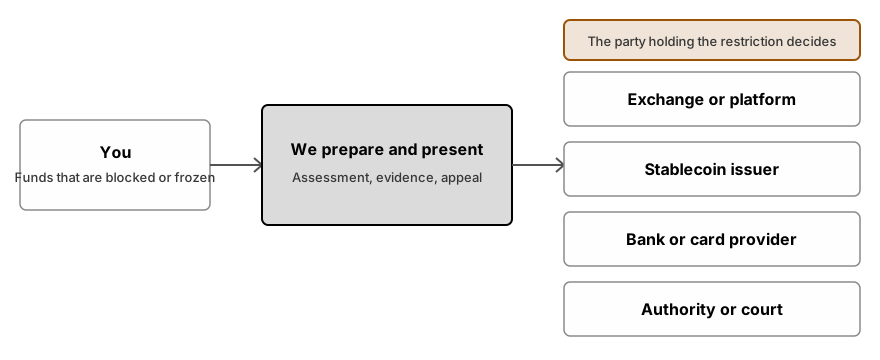
How a case runs
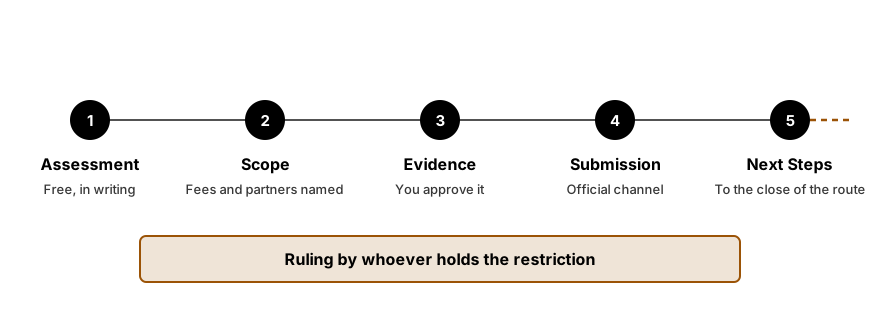
- Assessment, free
Input: the wallet, its networks and what you know. Output: written confirmation of fit, and a check against the minimum case size.
- Scope and fee
A written scope fixes the tasks, the pricing model and the named independent specialists and lawyers. Nothing is paid earlier.
- Building the case
Specialists analyze the chain history. Documents arrive through a secure channel, and gaps are closed before anything is sent.
- Case submission
Delivery is to the issuer, custodian or service; for an authority, counsel delivers it. Copies and every reference number reach you.
- Tracking and close
Responses are tracked and follow-up questions handled. If the route is exhausted, you are told plainly.
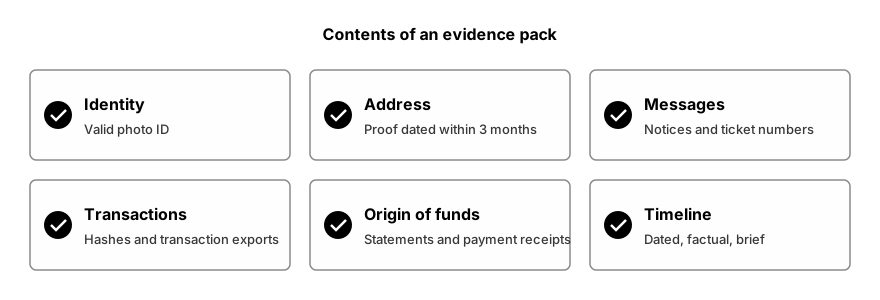
Inputs to prepare
- Frozen or flagged wallet addresses, with the network of each
- Hashes of the principal inbound and outbound transactions
- Proof of control over the wallet, supplied with no keys and no seed phrase shared
- For individuals, photo ID plus proof of address; for a business, company documents
- Acquisition records showing where the funds came from: bank transfers, invoices, exchange exports
- Every notice, email or ticket received from any party that holds the restriction
- A timeline of events in writing
What we cannot do
- A wallet cannot be unblocked by us. Only the party controlling the restriction can lift it, and that party decides.
- No issuer, custodian, service or authority can be forced to act, and neither a result nor a timeline is promised.
- The threshold is USD 50,000. Under it, specialist and legal costs usually exceed what a case can reasonably recover, so we decline rather than take a fee.
- Documents are never altered or backdated with our help, and cases without a realistic route are not accepted.
- A seed phrase, private keys, passwords or remote access are never requested.
Common situations
- The issuer froze a stablecoin balance at your address
- After a compliance review, a custodian keeps the wallet in a restricted state
- Screening tools flagged the address, and services now decline funds that come from it
- Freeze on one network, with funds bridged out of it carrying the same flag
- A counterparty's tie to a sanctioned or fraud address led to a restriction on a business wallet
- An authority request led to a hold, and the holder receives no information
This fits your case if
- A wallet or address is frozen, blacklisted or flagged, with a large balance stuck behind it
- The cause is a restriction set by an issuer, custodian or service, not a technical fault
- Funds sit on several networks and the restriction touches more than one
- An earlier attempt through standard support failed, and the sum is large enough for formal work
- A business has a frozen treasury or customer wallet that needs review
How long it takes
Duration varies widely. Reviews by an issuer or custodian can run for weeks, and legal process can run for months. An estimate follows the assessment and is updated.
Fees
The assessment is free. Cases begin at USD 50,000: paid analysts and, often, lawyers are part of the work. Fees are quoted in writing after the assessment, and none is requested before we say whether we can help. Fees →
Questions people ask
Which party is able to unblock a frozen wallet?
Only the one that placed or controls the restriction. For a stablecoin, usually the issuer. For a hosted account, the custodian or exchange. For an authority hold, the authority or a court. No third party can override them.
What justifies the USD 50,000 minimum?
Serious work involves blockchain analysts, document preparation and frequently a licensed lawyer, and each carries real cost. Under this size those costs would absorb most of the recoverable amount, so an early refusal is the honest answer.
Does the minimum act as a fee?
No. It marks the smallest balance we accept. The assessment is free, a fee model follows in writing, and no payment is due until we state whether we can help.
What applies to a case below USD 50,000?
Other pages here may fit better, such as exchange account unblocking or issuer appeals. Our guides also let you do much of the groundwork yourself. If we cannot take the case, we say so plainly.
Are private keys needed to unblock a wallet?
Never. Control can be proven without keys, for example by signing a message. Anyone who asks for a seed phrase or key is not acting in your interest; end contact.
Does one unblock cover every network?
No. Freezes usually attach to a token on a specific network, so one chain may be restricted while another is clear. Each network is mapped on its own, and the restrictions found are reported.
Related situations
- Diagnosing a crypto freeze. Identify the party behind a freeze and the realistic next step.
- Appealing a stablecoin issuer freeze. Evidence-backed appeal for a freeze by Tether, Circle or a comparable issuer.
- Blockchain analysis report. A source-of-funds report built by tracing transactions, formatted for a compliance team.
- When authorities freeze your crypto. When authorities hold your crypto, we arrange independent licensed lawyers. We give no legal advice.
Read next
Sources
This record is derived from external, primary sources. Validation depends on the source documentation. Changes occur; review the originating platform for current content.
The content on this page is general. It is not legal advice.