Documents an exchange compliance team requests, and how to present them
Status: Published: Last reviewed: Editorial policy
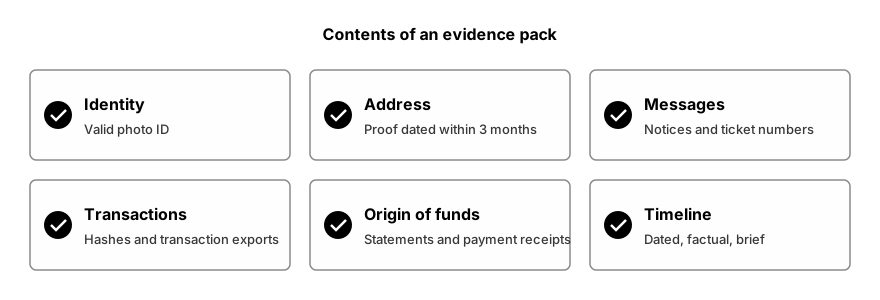
Exchange compliance teams typically request four document groups: a current photo ID, proof of address, evidence of the funds' origin, and proof that you control the wallet in question. Submit clear, complete, recent files as one organised package, plus a short cover note mapping each document to the question it answers. Never send passwords, seed phrases or unrelated private data.
Need a case detail checked? Send it here:
Start from the question, not the folder
Read the request a second time before gathering anything. The exchange states what it needs, sometimes in a single line. An identity check refresh requires different papers than an explanation of a large deposit.
List the questions in writing. Every document you prepare should answer one item on that list. If a question is unclear, request written clarification from the exchange before assembling a large package.
Identity and address documents
These files are the simplest to prepare, yet small details fail many reviews here. Reviewers cross-check the name, date of birth and address in every file you submit.
Submit documents that are current and carry the exact name spelling on the account. If the name changed, attach the record proving the change.
- Government-issued photo ID, unexpired, with all four corners fully visible.
- If the exchange requests it, supply an address proof no older than three months, for example a bank statement or utility bill.
- A sharp selfie or live video check when requested, captured in good light, no filters applied.
- Proof of a name change, for example a marriage certificate, where names differ across files.
- Company registration papers plus an ownership list, when the account belongs to a business.
Source of funds documents
Reviews stall most often at this group. The exchange requires a paper trail running from the money's origin to the deposit that triggered the review. For the distinction between source of funds and source of wealth, read the separate guide.
Match each document to the actual origin. A salary slip with a bank statement evidences a salary. An earlier exchange export plus bank transfers evidences trading proceeds. If origins mixed, document each part on its own.
- Bank statements showing the transfer of funds into the exchange or the wallet.
- Exports of past trades and account history from exchanges you used before.
- Contracts of sale, invoices, or receipts for payments on goods, services or property.
- If the funds originate from earnings, provide tax filings or payslips.
- A short written note covering any point the documents leave unexplained.
Proof of wallet control
If a self custody wallet, meaning a wallet you hold alone, is part of the review, the exchange may require evidence that the address belongs to you. No secret needs to be exposed for this.
The standard checks are: a message signed by the address, a small transfer of an amount agreed in advance, or a screenshot taken in a live session with the address visible. Use whichever check the exchange specifies. Keys stay private in every case.
Format and presentation tips
Clean files read as a reliable customer; disorganized files trigger questions and waiting. Submit one file per document, PDF where available, named clearly, for example bank-statement-2026-03.pdf.
Attach a single page listing each file and stating which question it answers. Keep the wording factual and brief. Do not argue, threaten or complain in that same message.
- Utilize color scanning or photography to capture complete documentation. Ensure images contain all edges and lack reflective glare.
- Prohibit the alteration or redaction of data beyond exchange-approved exclusions.
- Maintain document file size within maximum upload constraints to prevent fragmentation.
- Submit all documentation via the channel specified within the ticket, retaining the reference number.
- Archive records of submitted data alongside the date of transmission.
What Not to Submit
Submit only requested data. Excessive private information introduces security risks for you and review noise. Inclusion is restricted to data directly related to the inquiry.
Avoid transmission of seed phrases, private keys, passwords, or one time codes. Compliance personnel require none of these elements. Restrict documents to your ownership or original format.
Frequently asked questions
What is the required date range for proof of address submissions?
Platform requirements vary, often requiring documentation from the last three months. Verify the specific exchange request wording. If no timeframe is stated, provide the most current evidence available.
Am I allowed to redact sections of a bank statement?
Redaction is permitted only when the exchange accepts it. Typically you can cover unrelated transactions, but these inputs must remain visible: your name, the account number or IBAN, the date range and the lines that matter. Check before editing; a file that looks altered can be rejected.
What happens when no paperwork exists for a past transaction?
State the gap plainly and supply the nearest alternative evidence. Valid substitutes include an old exchange export, a bank record, or a signed statement from the counterparty. An honest explanation outweighs a fabricated document.
Is it better to submit everything in one batch or in stages?
Submit one complete package that resolves each item in the request. Repeated partial replies create confusion and can restart review timers. If a requested item cannot be produced, note that in the cover message.
Must my documents be translated?
Usually yes, if the language falls outside what the exchange accepts. Confirm two points first: whether a plain translation suffices, or whether a sworn translation is required. Attach the original file alongside the translation.
How we can help
- Sourcing of funds and wealth: document packs. Build a clear source of funds and source of wealth pack for exchanges, banks and processors.
- Unblocking a restricted exchange account. Read the freeze, build KYC and AML evidence, answer compliance, appeal.
- Diagnosing a crypto freeze. Identify the party behind a freeze and the realistic next step.
- Wallet risk flags and how to dispute them. Screening tool flags your address as high risk: record the fund path and dispute it.
The content on this page is general. It is not legal advice.