
DeFi exploit, bridge hack or malicious approval: what action can realistically recover funds
Status: Published: Last reviewed: Editorial policy
On-chain transfers have no reversal mechanism. Most funds taken by DeFi exploits, bridge hacks or malicious approvals stay lost. A minority of cases give you a window of action: stolen assets can pass through an exchange, a stablecoin issuer or a protocol that holds pause powers. Speed and a clean trace determine the outcome. We trace the flow, alert the parties who hold control and handle reporting. No return can be promised.
Need a case detail checked? Send it here:
What we do
- Lock down remaining assets
We guide you step by step through revoking token approvals, then transferring what remains to a fresh wallet that you create yourself. Do this on your own device. We never request your keys or a seed phrase.
- Follow the stolen assets
Independent specialists track the funds from your wallet across swaps, bridges and mixers, searching for slow points such as exchange deposits, stablecoin balances or contracts that can freeze.
- Notify exchanges, issuers and protocols
If the trace ends at a party that can act, we draft a notice containing transaction hashes, wallet addresses and a brief summary. It goes to whichever exchange, issuer or protocol team controls the ability to pause or flag.
- Draft the report for regulators
We turn the incident into a factual report: a timeline, a loss figure and the supporting evidence. Use it for a police report or a cybercrime complaint, if such a unit exists in your country.
- Align the legal tracks
Where the attacker can be identified or a company is involved, we connect you with an independent lawyer. That lawyer can advise on claims, court orders and cross-border steps, under their own engagement.
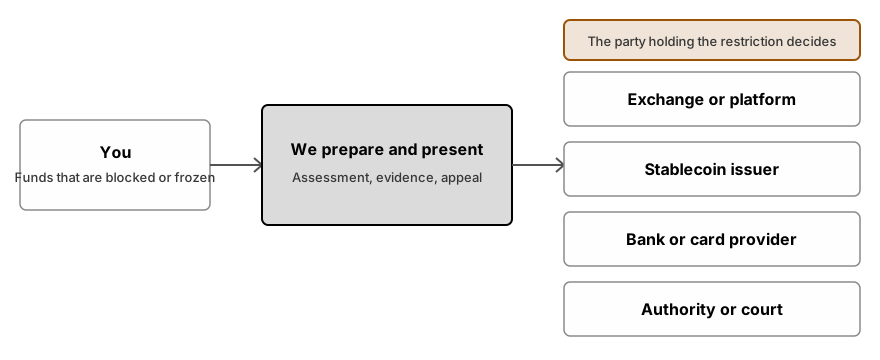
How a case runs
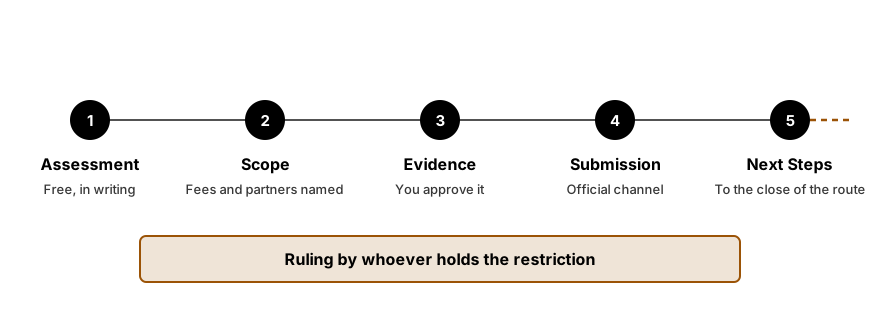
- Free initial review
List what you approved, when the approval happened, and each wallet address involved. We answer in writing with a candid assessment of whether a trace has a viable path and whether our service fits the case.
- Scope and fee, confirmed in writing
If you decide to continue, the first output is a written scope document listing the fee model and naming the independent analysts assigned to trace the funds. No charge occurs until you have accepted that document.
- Tracing and mapping
The analysts map the trajectory of the assets. We provide a concise summary of the asset path, defining points where funds are accessible and points where funds are non-recoverable.
- Formal Filings and Notifications
We initiate alerts and compile the required report package for authorities. The client receives copies of all submitted documentation and any resulting reference numbers.
- Review Case Status and Finalization
We provide case status updates regarding all external replies and define the definitive termination of the engagement. The service does not maintain an open case file for fee collection.
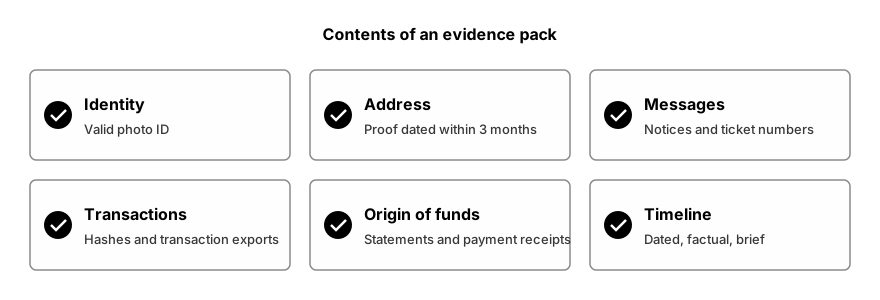
Inputs to prepare
- Input requirement for the wallet addresses: client address, known malicious address, and relevant contract address.
- Transaction hashes required include approval events, theft confirmations, and subsequent movement records.
- Photographic evidence of the platform, message, or application prompting the signing of the transaction.
- Wallet or exchange history records documenting the balances prior to the financial loss.
- Copies of all correspondence, including project support communications or direct interaction with the attacker.
- Evidence of how the lost assets were acquired, if such records exist
- A written timeline covering the period from first contact through discovery of the loss
What we cannot do
- On-chain transfers lack an undo path. Once recorded, a transaction cannot be reversed by us, and no exchange, issuer or protocol can be compelled to freeze or return assets.
- Most DeFi and bridge cases carry a low recovery probability. We state no promise of return and we decline any case we judge to lack a realistic route.
- This service does not perform hacking, counter-attacks, or negotiations with attackers on your behalf.
- No request for a seed phrase, private key, or wallet password will be made. Any such request is not from this service.
Common situations
- Wallet emptied after connecting to a fake site and approving a token spend
- Liquidity drained from a position after a protocol exploit
- Assets taken or locked up during a hack of a cross-chain bridge
- Rug pull: the team pulled the liquidity and vanished
- Token or NFT holding a hidden approval that a malicious contract triggered
- Stolen assets traced to a deposit address at an exchange
- Wallet compromised, and the attacker is already swapping assets
This fits your case if
- Your wallet was drained because you signed a transaction, either a malicious contract call or an approval, that handed out control
- Funds disappeared when a DeFi protocol or cross-chain bridge got exploited
- A phishing site or fake airdrop induced you to grant token permissions
- You require a clean trace plus a report for exchanges, protocols or police
How long it takes
Response time is critical during the initial hours, but tracking and resolution may extend over weeks. Exchange and protocol reply times are inconsistent. After the evaluation we provide an estimate and revise it when the situation shifts.
Fees
The assessment carries no charge. Its output is a written scope and a fee model for your case. We request no fee until we have stated whether we can take the case. Fees →
Questions people ask
Is it possible to get back funds taken in a DeFi exploit?
Rarely, and only under specific conditions. A return becomes possible mainly when stolen assets hit an exchange or a stablecoin issuer with the control to freeze them, or when the exploited protocol negotiates their surrender. In most cases funds are swapped or passed through mixers fast, and no recovery outcome follows.
Can a blockchain transaction be undone?
No. After a transfer is confirmed on-chain, no party can reverse it, including us. Recovery relies on third parties who may freeze or return assets, and they decide at their own discretion.
What comes first after signing a malicious approval?
Revoke the approval with a trusted tool, transfer remaining assets to a new wallet set up on a clean device, and record the transaction hashes. Never click recovery offers from strangers. Many are scams.
Why the warning about recovery scammers?
When crypto goes missing, scammers follow. Fake recovery services send unsolicited messages that ask for an upfront payment or a seed phrase. That request is the trigger: legitimate help never needs your keys. Our service also states plainly that no outcome is certain.
Is a bridge hack different from wallet theft?
Yes. A bridge hack usually affects many users simultaneously, and the project may operate its own recovery or compensation plan. Follow official project channels and retain proof of your holdings.
Should the police be notified?
Yes, in most cases. A police report supports later requests to exchanges and can back insurance or tax claims. Prepare a clear timeline, addresses and hashes. Cybercrime units respond differently by country.
Related situations
- Tracing stolen crypto, sending freeze requests. Tracing, freeze requests to exchanges and issuers, and police report support.
- Blockchain analysis report. A source-of-funds report built by tracing transactions, formatted for a compliance team.
- When authorities freeze your crypto. When authorities hold your crypto, we arrange independent licensed lawyers. We give no legal advice.
Read next
Sources
This record is derived from external, primary sources. Validation depends on the source documentation. Changes occur; review the originating platform for current content.
The content on this page is general. It is not legal advice.