
Exchange account blocked: the KYC and AML review, and the appeal
Status: Published: Last reviewed: Editorial policy
An exchange blocks an account while a compliance check is open. Typical checks: identity verification, source of funds, a risk flag on an incoming deposit, a legal request. The exit is seldom a complaint. It is a complete, consistent answer to the exact question compliance asked, sent through the correct channel and kept in writing. We establish what was asked, assemble the evidence and file the appeal. We cannot make an exchange release funds.
Need a case detail checked? Send it here:
What we do
- Establish the exact question asked
Messages, tickets and notices are read, and what the exchange stated is separated from what it implied. Most stalled cases trace to an answer given to a different question than the one compliance posed.
- Match past transactions against the probable cause
Deposits and withdrawals near the date of the restriction are reviewed for the patterns reviewers check first: counterparties, timing, amounts and the origin of incoming funds.
- Assemble the evidence pack
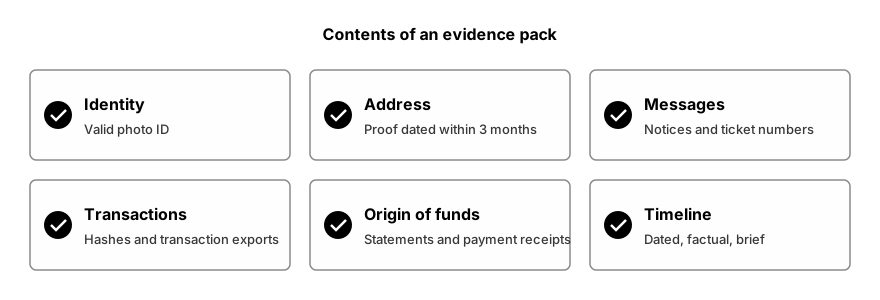
Contents: ID, proof of address, bank and wallet statements, purchase records, and a plain written account of the funds' origin, laid out so compliance staff can process it.
- Write the response and the appeal
The response is factual and internally consistent; a formal appeal follows where needed. Each text names the question it answers, attaches the evidence and requests one specific outcome.
- Escalate by the formal route
When the standard channel stalls, the options are: the exchange's own escalation route; a complaint to a regulator or financial ombudsman, in jurisdictions that have one; a lawyer, if the case needs one.
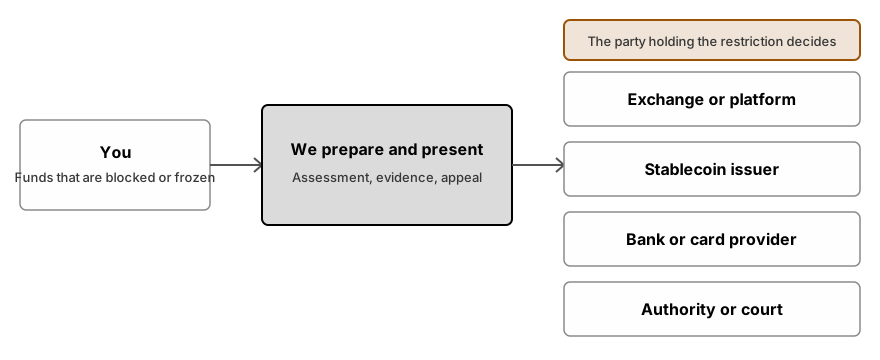
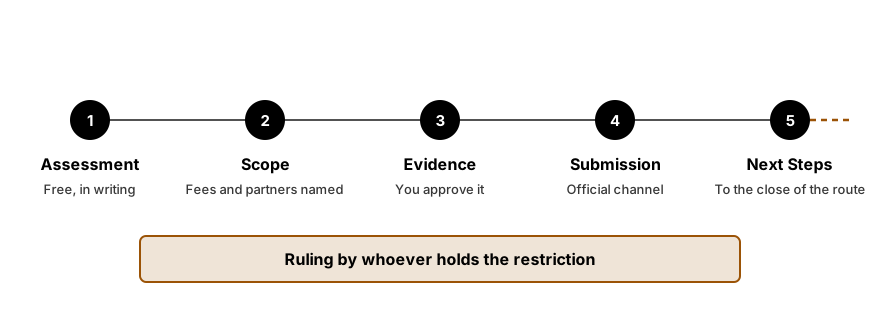
How a case runs
- Assessment, free
Input: your account of events and the messages received. Output: a written statement of whether we can help, the likely reason and what we would need.
- Scope and fee
If the case proceeds, the scope, the fee model and the independent specialists involved are issued before any payment.
- Evidence intake
Documents come in through a secure channel and are checked for gaps and contradictions before anything is sent.
- Filing
The response or appeal goes through the exchange's official channel. A copy and the reference number come back to you.
- Tracking
Replies are tracked and follow-up questions handled. When the case has reached the limit of what can be done, you are told plainly.
Inputs to prepare
- Valid, legible government photo ID
- Proof of address from the last three months
- Exchange messages and notices, as screenshots or exports
- The exchange's transaction history for the period concerned
- Bank statements or purchase receipts that show the first acquisition of the funds
- Addresses of wallets you control, plus proof of control if asked
- A short timeline in writing: how the funds were obtained, and on which dates
What we cannot do
- An exchange cannot be compelled by us to release an account. It decides within its own rules and the law that binds it.
- No result or timeline is promised, and a case without a realistic route is not accepted.
- Documents are never fabricated, altered or backdated with our help. Where evidence does not exist, that is stated.
- A seed phrase, a private key or an exchange password is never requested.
Common situations
- Withdrawals switched off following a large deposit or a run of transfers
- Account limited after a deposit arrived from a wallet flagged by the exchange's analytics tooling
- KYC tier lowered, or verification recorded as failed
- Freeze following a new country, device or IP address
- A time limit applies to a request for proof of fund origin or of overall wealth
- Closure notice tells you to withdraw, yet the withdrawal itself is blocked
This fits your case if
- The account displays a restriction, a held withdrawal or a notice that a review is running
- Support repeats one template reply and the missing item is never named
- A request arrived for source of funds, proof of address or a video check, and the correct answer is unclear
- An appeal was rejected, or the case closed with no reason that allows a next move
How long it takes
Duration is set by three inputs: the exchange, the reason for the review and the time needed to obtain missing documents. An estimate follows the assessment and is revised as the case moves.
Fees
The assessment is free. A written scope and fee model for your case type follow it. No fee is requested until we have stated whether we can help. Fees →
Questions people ask
What typically triggers an exchange account block?
Usual triggers: an open KYC or AML review, an incoming deposit that raised a risk flag, activity out of line with your profile, a changed location or device, or an authority request. Notices tend to give just a category. The precise trigger must be deduced from the facts around it.
Can an unblock be assured?
No one can promise that, because the exchange makes the final call. What we control is the quality of your side: a complete, consistent response through the right channel. Most avoidable delay comes from gaps there.
How do KYC and AML differ here?
KYC checks who you are. AML examines where the money came from and how it moved. An account can clear KYC and still be restricted after an AML review of particular transactions.
Is repeated contact with support useful during a review?
Answer exactly what is asked, once and in full. Repeat tickets and contradictory messages can reset the queue or read as inconsistency. Keep every exchange in writing.
What if a requested document does not exist?
Tell us before replying. Substitutes are frequently accepted: a bank record can stand in for a purchase receipt, an exchange export for an older trade. Never send altered material, and never guess.
When does a lawyer become necessary?
Rarely at the start. The point arrives if the exchange stops responding, if law enforcement is involved or if the sum justifies formal action. We flag when that point is reached.
Related situations
- Diagnosing a crypto freeze. Identify the party behind a freeze and the realistic next step.
- Sourcing of funds and wealth: document packs. Build a clear source of funds and source of wealth pack for exchanges, banks and processors.
- Sanctions and AML false positives: support. Wrong sanctions or AML match: evidence pack plus a lawyer-filed statement to clear the flag.
- Procedure for Account Termination and Offboarding Management. Received a closure notice while your balance is still in? We draft written requests and escalate.
Read next
Sources
This record is derived from external, primary sources. Validation depends on the source documentation. Changes occur; review the originating platform for current content.
- Why is my account restricted? · Kraken
- Resolve your account restriction · Coinbase
The content on this page is general. It is not legal advice.