
Circle (USDC) blocked or frozen address: what Circle's official pages state
Status: Published: Official pages last read: Editorial policy
Circle states it can block an address from sending or receiving USDC under narrow conditions: legal orders, urgent government requests, or security threats. Blocklisting stops further transfers; it does not reverse a completed transfer. Removal depends on an authority lifting the order or the security issue ending. If funds moved without consent, Circle advises contacting law enforcement first.
We operate independently of Circle (USDC) and have no affiliation with it. Its decisions are outside our control, and nothing here is an official statement by Circle (USDC).
Need a case detail checked? Send it here:
What the platform's own pages state
- Per Circle's help article, it may block an individual blockchain address so that it cannot send or receive USDC or EURC, in certain limited circumstances; its Stablecoin Access Denial Policy explains this. [1]
- The article explains that blocklisting, also termed access denial or freezing, differs from reversing a transaction. USDC and EURC transfers are irreversible, so Circle cannot reverse or recall a completed transfer. [1]
- The listed circumstances cover compliance with laws and with valid legal orders issued by a recognised US or French court or authority, certain urgent government requests, and cases where Circle itself determines, in its sole discretion, that a security threat requires action. [1]
- Per the article, transfers to or from a blocked address may fail, and funds tied to that address may stay inaccessible for as long as the blocklisting remains in effect. [1]
- According to Circle, an address comes off the blocklist once the relevant authority formally confirms the legal obligation or order is lifted, or once a security incident no longer requires the restriction. [1]
- Per the platform's official guidance, if funds moved without your consent, contact local law enforcement promptly. Provide the sending and receiving addresses, transaction hash, date, time, and amount. [1]
- Per the article, law enforcement may deliver valid legal process straight to Circle, which then reviews it under its own policy and applicable law. [1]
- Circle's v2.2 announcement states that the blocklisting function in its smart contracts enables Circle to stop named addresses from sending or receiving USDC and EURC, and that this follows its Access Denial policy. [2]
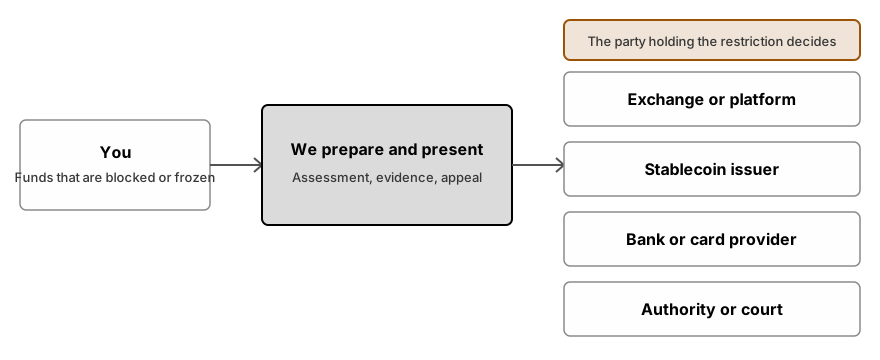
Typical restrictions
| Restriction type | Meaning |
|---|---|
| Block triggered by a legal order | A trigger listed by Circle is an address appearing on the blocklist. Removal depends on the authority confirming the order is no longer in effect. |
| Urgent government request as trigger | Circle states it may respond to certain urgent government requests. The request path is not described in the article, so the channel runs through the authority rather than the holder. |
| Security threat as trigger | If Circle decides, at its sole discretion, that a block is needed to protect its network's security or reliability, it may block the address. Once the incident no longer justifies it, the block can be removed. |
| Blocked address: funds cannot move | A transfer to or from an address under block can fail, and the funds can stay unreachable until Circle lifts the block. Circle states that a block does not reverse a transfer. |
What you can do, step by step
- Check whether the address is really blocked
Other causes can make a transfer fail. Read the transaction details, then ask your wallet or exchange if the error indicates a block on the address.
- Identify the cause
Ask the party that notified you, for example a platform or an authority, whether a court order, a government request or a security matter triggered it. Circle's article names those as the main grounds.
- Gather evidence of ownership and origin
Assemble records showing you control the address and records showing where the funds came from. Any party you deal with can use this evidence.
- Bring in a lawyer when an order is involved
Per the article, a block rests on legal obligations or orders, and Circle removes it once an authority confirms they no longer apply. A lawyer can contact the authority in question.
- Report the theft to police before anything else
If your funds moved without your consent, then the first step is a report to local law enforcement. Circle recommends doing this promptly. Include the address, the hash, the date, the time and the amount in your report.
- Contact Circle support only via official pages
Circle lists a contact route on its own help pages. Open circle.com directly. Do not follow contact links sent by unknown senders: those may be fake.
Inputs to prepare
- The blacklisted address, with the token name typed out in plain text
- Transaction hashes, each with its date, time and amount
- Evidence that you hold control over the address
- Records showing the source of the funds
- Any notice or order received from a platform or an authority
- A police report number, if the funds moved without your consent
Pitfalls and scams to avoid
- Do not provide seed phrases, private keys, or passwords to any entity claiming the ability to remove your address from a blocklist.
- Never pay a party advertising fast removal. Under the article, removal rests on an authority decision or a closed security incident, not on a purchasable service.
- Avoid websites requesting a wallet connection to verify or unlock an address. Draining of funds is a possible outcome.
- Treat unsolicited recovery offers for stolen USDC as a trigger for caution. Per Circle, a completed transfer cannot be reversed or recalled.
When outside help makes sense
- A legal order or an investigation appears to sit behind the block
- A large balance is frozen and the holder of the restriction is unclear
- Evidence of control and origin must be organised for an authority or a lawyer
- Funds were stolen and the facts need documenting fast for the police
Questions people ask
What would cause Circle to block a USDC address of mine?
Circle's published help page states three triggers for address blocking: compliance with laws and valid legal orders, certain urgent government requests, and a sole-discretion security-threat determination. The page provides no per-address selection criteria.
Can Circle reverse a USDC transfer?
No. Per the article, USDC and EURC transfers cannot be undone, and Circle holds no mechanism to reverse or recall a completed one. Blocklisting is different: it stops an address from sending or receiving.
Can a blocked address be unblocked?
Under the article's terms, Circle may lift a restriction when an authority formally confirms the legal obligation or order has ended or no longer applies, or when a security incident no longer justifies it.
My USDC got stolen: what steps should I take now?
Circle's published guidance states the initial step is to report the incident to local law enforcement. Provide the sending and receiving addresses, transaction hash, date, time, and amount. Law enforcement can then issue valid legal process to Circle.
Which mechanism does Circle employ for the submission of evidence against a frozen USDC address?
The help article sets out the grounds and the removal conditions and provides a general contact route, but no dedicated appeal form appears in it. If a legal order caused the block, the authority plus a lawyer is the usual path.
Is Circle required to notify me when it blocks an address?
The help article states no notification commitment. If your platform informed you of a block, ask it which notice it received and from whom.
Does this interface represent Circle's official documentation?
No. TraceStolenCrypto operates independently of Circle and has no affiliation with it. TraceStolenCrypto summarizes Circle's published pages and provides links to them. TraceStolenCrypto cannot affect any decision regarding a blocked or frozen address.
Related services
- Appealing a stablecoin issuer freeze. Evidence-backed appeal for a freeze by Tether, Circle or a comparable issuer.
- Unblocking a crypto wallet. Case preparation and presentation for frozen or flagged wallets, from USD 50,000.
- Tracing stolen crypto, sending freeze requests. Tracing, freeze requests to exchanges and issuers, and police report support.
Read next
Official pages read
This record is derived from external, primary sources. Validation depends on the source documentation. Changes occur; review the originating platform for current content.
- Understand Circle's stablecoin blocklisting process · Circle
- Announcing USDC v2.2 · Circle
The content on this page is general. It is not legal advice.