
Blockchain tracing: the mechanism, its outputs, and its limits
Status: Published: Last reviewed: Editorial policy
Blockchain tracing follows transfers across a public ledger, address by address. Analysts cluster addresses that likely share one owner, attach labels to known services, and search for the hop where funds land on an exchange or another service that keeps customer identities. The output is a record of where the money moved. It cannot, on its own, establish identity or recover funds.
Need a case detail checked? Send it here:
A public ledger records movement, not names
Most major blockchains write every transfer to a public ledger. Anyone can verify that one address sent a given amount to another address at a given time. No name is required to create an address.
The ledger is therefore open but pseudonymous. You can track the money in fine detail, yet the record itself never states who controls each address. Tracing is the work of closing that gap, limited by what the evidence allows.
How analysts follow the funds
The basic step is to follow outputs. From a known address, an analyst checks where the funds moved next, then where they moved after that. Software renders these hops as a graph, so a long chain becomes readable at a glance.
Analytical tools record transfer timing, amounts, and sequence patterns. Rapid, fragmented transfers suggest obfuscation of the funding pathway. The analyst documents these patterns without assigning them definitive evidentiary status.
- Trace each hop from the first address onward, address by address, until the chain of transfers ends.
- Record the amounts, timestamps and networks involved, including any cross chain bridges.
- Identify and record recognized entities: exchanges, payment processors, and smart contracts.
- Record where the trail stops or turns uncertain, and state the reason.
How addresses get clustered and labeled
Clustering groups addresses that likely share one owner. The grouping relies on heuristics, meaning rule-of-thumb tests: for example, multiple addresses used as inputs in a single transaction, or a change address reused across transfers. Treat each cluster as an educated guess, not a verified fact.
Labels attach a name to a cluster: an exchange, a gambling site, a known scam wallet. The label source is public material, direct knowledge of a service, or reports. A label can be wrong or stale, so a careful report states its confidence level explicitly.
Tracing Obstacles: Analysis of Mixers and Intermediary Systems
Mixers combine deposits from many users, then pay out new amounts. That breaks the direct input-output link on the ledger. Bridges and swaps move value onto another network, so the trail must be restarted there. Privacy coins and chain hopping add further steps.
A mixer does not automatically terminate a trace. Analysts can still estimate connections from timing and amounts. However, a post-mixer output is usually a probability rather than a fact, and a report must state this limitation.
Exchanges as exit points
Regulated exchanges and comparable services collect identity documents from customers. If disputed or stolen funds land on a deposit address at such a service, that service controls the records identifying who owns the account. This is the reason exit points matter.
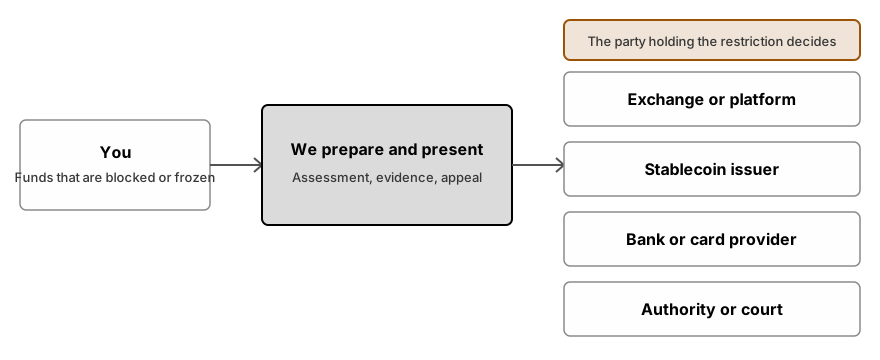
A trace can identify the service. The service then chooses its action, following a police report, a court order or a valid request. Options include freezing the account, requesting evidence or declining. We have no mechanism to compel an exchange to act.
What a trace can and cannot show
A sound trace can display the route of funds, the handoff points, the services involved and the elapsed time. It can back a police report or a request to an exchange or issuer.
It cannot establish a person's identity, the purpose behind a transfer, or certainty for every link in the chain. It cannot reverse a transfer. If a case needs a trace, an independent analyst can prepare a report, and we can help scope the request and direct it to the correct party.
Frequently asked questions
Is it possible for anyone to trace my crypto transactions?
Public ledgers can be read by anyone, so transfers on those chains are visible. Connecting an address to a real person requires additional data, such as exchange records or other information. Casual viewers see addresses, not names.
Can a trace reveal who the scammer is?
No. A trace on its own produces addresses and flows, not names. If the path ends at an exchange or another service that verifies identity, that service holds the identifying records. Police or a court must request those records from it. The outcome depends on that service's policy and on the law that applies in its jurisdiction; neither is verifiable from outside.
Can a mixer make traced funds untraceable?
Tracing becomes harder and less certain, but it does not always stop. If timing and amounts line up, analysts can sometimes estimate links between addresses. The output of such estimates is a probability, not a match. Any report should state how reliable each result is.
How accurate is the labeling of addresses?
These data points possess utility but are subject to inherent constraints. Label provenance derives from multiple sources; these inputs may contain inaccuracies or obsolete records. We cross-reference critical parameters against independent systems and report the resulting confidence rating.
Does a tracing report produce a recovery of funds?
No. A report functions as evidence. It can back a request submitted to an exchange, an issuer or the police, but each of those parties holds the control and decides the outcome. If a party rejects the request, that outcome stands. No result is guaranteed, and no one can promise that funds will be returned.
How we can help
- Blockchain analysis report. A source-of-funds report built by tracing transactions, formatted for a compliance team.
- Tracing stolen crypto, sending freeze requests. Tracing, freeze requests to exchanges and issuers, and police report support.
- DeFi exploit and bridge hack: response runbook. Tracing, alerts and reporting after an exploit, bridge hack or malicious approval.
- Wallet risk flags and how to dispute them. Screening tool flags your address as high risk: record the fund path and dispute it.
The content on this page is general. It is not legal advice.