
Due diligence on counterparties: risk checks for crypto firms
Status: Published: Last reviewed: Editorial policy
Due diligence is the check of who you are dealing with before money moves. It covers who controls the counterparty, where its funds originate, whether the entity or its wallets carry sanctions, fraud or adverse media exposure, and how much risk follows from that. We coordinate independent specialists who deliver a written, evidence-based assessment. The output informs your decision. It is not an audit, not a legal opinion, and not a statement that a counterparty is clean.
Need a case detail checked? Send it here:
What we do
- Set the decision and your risk appetite
First, we record the decision you face, its deadline, and the level of risk you will accept. A report that answers an unasked question wastes time; this step prevents that outcome.
- Verify ownership, identity and licence claims
Specialists, where lawful, examine corporate registers, ownership records, director details, stated licences or registrations and public records. Anything that conflicts with what the counterparty told you gets flagged.
- Check people, entities and wallet addresses
Screening runs against sanctions lists, politically exposed person data and adverse media; blockchain analytics then shows wallet exposure. A human reviews every hit, since tool matches can be wrong or stale.
- Score the risk, attach the evidence
Each risk area receives a clear rating from the specialists, backed by the supporting evidence, a list of what could not be verified and questions to raise with the counterparty. Ratings are professional judgement; the reasoning stays visible.
- Feed the decision and the record
Findings become a decision record with your team's input: approve, approve with conditions, request more information or decline. That record sits in your files, ready for a bank or auditor.
How a case runs
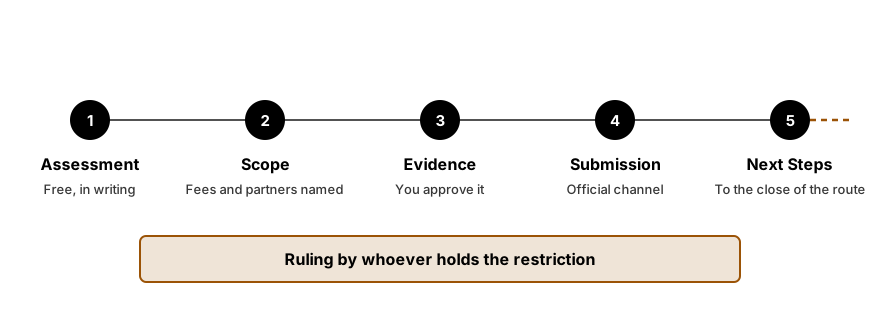
- Free initial review
State who or what needs assessment and your deadline. We confirm in writing whether independent specialists can answer the question and what information they require.
- Scope in writing, plus fee
You get the scope, the data sources for specialists, the deliverable, and the fee model in writing. Work begins only after your approval.
- Send information request
The specialists issue a document and question list to you or the counterparty. We log each received item and flag the gaps.
- Check and report
Specialists verify sources, screen the counterparties and their wallets, then draft the report. We check the draft for clarity and for claims the evidence does not support.
- Review and Debrief
We present the findings to your team, respond to questions and set follow-up actions. The final decision remains yours.
Inputs to prepare
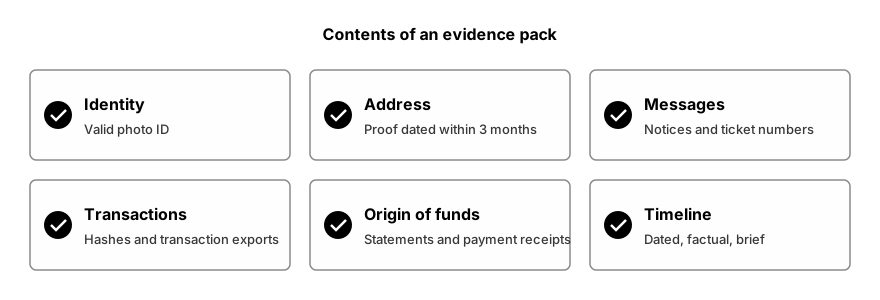
- Name, registration number and country of every company or person under review
- Corporate records: certificate of incorporation, ownership chart, list of directors
- Proof of any licence or registration the counterparty claims to hold
- Wallet addresses and exchange accounts that the counterparty intends to use
- Proposed deal parameters: purpose, amounts, currencies, timing
- Define the inputs: your risk appetite, your onboarding policy and any rating criteria already in use.
- Supply any earlier screening results, known news items and known complaints.
What we cannot do
- A due diligence report states what sources displayed on the review date. It is not an audit, credit rating, legal opinion, or good standing certificate.
- We do not obtain private records or utilize unlawful means. We base findings on public sources, supplied documents, and tool output, which is potentially incomplete.
- Approval decisions remain yours. A bank, regulator or counterparty is under no obligation to accept a rating. We do not state that any counterparty is free of risk.
- Treat a report from us as one input to your decision. We are neither an auditor nor a law firm, and no legal advice is given.
- No input of a seed phrase, private key or password is requested, from you or from the counterparty. The work never requires access to your funds.
Common situations
- A potential partner declines to name its owners or trace the source of its funds
- A client wallet carries indirect links to a mixer or a sanctioned service
- Before adding a token or opening in a new country, a documented assessment of the risks is required
- A bank wants an example of how you assess counterparties
- A target claims it holds a licence and meets compliance rules, and that claim needs verification
- An OTC trade of significant size awaits your approval while the counterparty's file remains incomplete
- The scheduled review of your high-risk customers has passed its due date
This fits your case if
- A crypto business preparing to take on a corporate client, an OTC desk or a liquidity partner
- Founders reviewing a prospective acquisition, deal or investment target in the crypto space
- Finance teams accepting large crypto payments that must confirm the sender is acceptable
- Compliance staff who must produce a written risk rating, either for a flagged customer or for entry into a new market
- Treasury managers seeking to check the wallets and exchanges they rely on
How long it takes
Timing depends on how many counterparties are involved, which jurisdictions they sit in, and how fast each party returns documents. One simple counterparty needs less time than an ownership chain with several tiers. Dates are fixed in the written scope before work starts.
Fees
The initial assessment is provided without cost. A formal quote is documented for the defined scope of the review. Specialist fees are presented separately. Disbursement is required only after assistance is confirmed and the quote is accepted. Fees →
Questions people ask
How does due diligence differ from KYC?
KYC is the routine identity check a firm runs on each customer. Due diligence applies to one counterparty or transaction: it covers ownership, source of funds, reputation, wallet exposure and why the relationship exists. If risk runs higher, then enhanced due diligence applies, which requires more evidence and a decision at a senior level.
What does enhanced due diligence involve?
Enhanced due diligence is a deeper review triggered by elevated risk, for instance politically exposed persons, high-risk countries or unusual ownership structures. The input is more documents; the checks cover source of funds; the output is a recorded senior decision. Which jurisdictions require it, and when, differs.
Is it possible for you to check whether a given wallet is safe to receive funds from?
Analysts review wallet exposure for indicators related to sanctions, mixers, scams, and darknet services. This review outputs risk indicators based on the check date. We state that this record does not deliver a verdict on the owner, nor does the service attest to safety.
Do you check beneficial owners?
Specialists compare the ownership data the counterparty gives you against public registers, where such registers exist. In some countries they are limited or closed. If ownership cannot be verified, the report states this and logs it as a risk factor.
Does the opposing entity detect that our system is initiating an external validation check?
Usually yes: part of the process is that you request documents from them. Checks of public sources make no contact with the counterparty. The written scope sets out which steps involve contact, and your onboarding terms should disclose that screening takes place.
How often should due diligence be repeated?
No fixed interval applies; the trigger is your policy plus the risk level of each relationship. If a relationship carries higher risk, review it more often. Events also force a new review: a change of owner, a news item, or a sanctions update. We help you set a simple schedule.
Related situations
- Crypto AML compliance consulting for businesses. Specialists assist with developing or auditing AML policies and risk assessments.
- Advisory on transaction monitoring for crypto firms. Build scenarios, thresholds and alert procedures covering on-chain and off-chain activity.
- Blockchain analysis report. A source-of-funds report built by tracing transactions, formatted for a compliance team.
- Sourcing of funds and wealth: document packs. Build a clear source of funds and source of wealth pack for exchanges, banks and processors.
Read next
Sources
This record is derived from external, primary sources. Validation depends on the source documentation. Changes occur; review the originating platform for current content.
- Guidelines amending the ML/TF Risk Factors Guidelines (EBA/GL/2024/01) · European Banking Authority
- EBA publishes final revised Guidelines on money laundering and terrorist financing risk factors · European Banking Authority
- Application of FinCEN's Regulations to Certain Business Models Involving Convertible Virtual Currencies (FIN-2019-G001) · Financial Crimes Enforcement Network (FinCEN)
The content on this page is general. It is not legal advice.