Exchange compliance review timelines: what controls the length of the wait
Status: Published: Last reviewed: Editorial policy
No fixed length exists, because the duration depends on the review's trigger, how complete your inputs are, and the team's workload. Not one exchange offers a guaranteed timeframe. The Kraken help page states that reviews typically run 10 to 14 business days. The Coinbase page states that restriction resolution usually runs up to 10 business days, with some cases running longer. The remaining platform help pages we reviewed state no general review time.
Need a case detail checked? Send it here:
What official help pages state about timing
Most exchanges publish no deadline for a compliance review, and no exchange can promise one. Two help pages do state a rough range. Those two figures are the only time numbers on this page. Treat them as a baseline for what is normal, then check your own exchange's current page, because help pages change.
The Coinbase figure appears on a page covering restrictions that Coinbase ties to security concerns, such as suspected malicious activity. It may not cover every review type. The Kraken page spans a broader set of temporary restrictions, including legal and regulatory requirements. Both pages state that some cases can exceed the usual range.
The remaining platform help pages we read for this site state no general review time. A few give a figure for one narrow step, such as a single appeal type, and that figure does not apply to a full compliance review. Record the date your restriction started, so you can tell when a stated range has passed.
| Platform | Stated timeframe on the help page | Scope of the page |
|---|---|---|
| Kraken | The platform states that a review normally runs 10 to 14 business days, with extensions possible during high volume. | Temporary limits triggered by, for example, unusual activity, expired or outdated ID records, a reversed payment, or a legal hold. |
| Coinbase | Per Coinbase's help page, resolving a restriction and processing the review typically takes up to 10 business days; individual cases can exceed that window. | Account restrictions the page connects to security-related triggers. Coinbase states it sends an email once the review closes. |
| Other platforms | The pages we read give no general review duration. | A few list a duration for one narrow step only, for example one appeal type. |
What controls the length of your review
Wait times differ between accounts even under the same review process. Some triggers sit outside your control. Others do not, so the input you control first is the answer you submit and the records behind it.
- The trigger for the review. An identity refresh request is often simpler to close than a question tracing the origin of a large deposit.
- How complete the answer is. Missing pages, unreadable scans and skipped questions return the file to you. Kraken's help page notes that partial answers can add days.
- Whether your documents match each other. Mismatched names, dates or amounts across files trigger follow-up questions.
- How busy the reviewing team is. Kraken's help page notes that reviews can take longer during busy periods.
- Whether another party holds control. If a court order or an authority request sits behind the restriction, the exchange may depend on that body's timeline.
- How much activity needs explaining. A short, clean record checks faster than years of movement across many wallets and platforms.
Review stages and who is waiting on whom
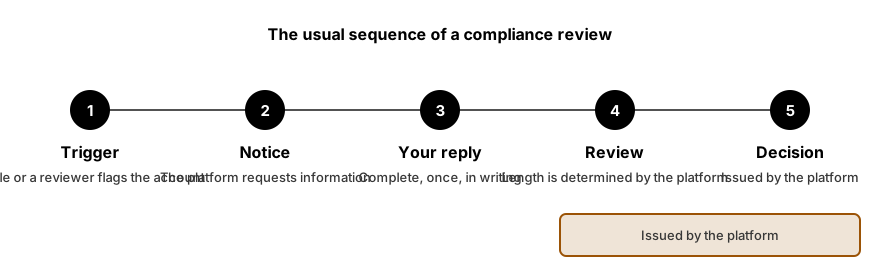
Each exchange labels its process differently, so read this as a common pattern rather than the procedure of a single platform. Nearly all reviews move through similar steps. The longest delays usually occur at the points where the exchange is waiting for input from you.
Use the table to locate the likely state of your case. If the stage belongs to you, act first. If the exchange holds it, wait out the stated range before you send a follow-up.
| Stage | What normally happens | Waiting party | Recommended Procedure |
|---|---|---|---|
| Notice | The account gets limited. A notice or banner gives a general reason, or names only a category. | You are waiting to learn what it means | Read it carefully, record the deadline and the channel, and keep a saved copy. |
| Request for information | The exchange requests identity documents, proof of address, or evidence showing where the funds originated. | Exchange holds the file; your input is missing | Submit a single, complete reply via the channel stated in the notice, and retain the reference number. |
| Document check | A reviewer, or an automated check, compares your submission against the account record. | Exchange review stage | Remain inside the stated range, and avoid new transfers that create further activity to explain. |
| Follow-up questions | The reviewer might request a missing page, a sharper scan, or a brief written explanation. | Exchange holds the file; your input is missing | Input mandated information within the existing communication thread to minimize processing delay. |
| Decision | The system will result in restriction release, constraint adjustment, or account termination. | Exchange review stage | Review the status output; if the restriction remains, request specific data requirements. |
| Escalation or appeal route | Second review availability varies across platforms; others lack documented routes for appeal. | Set by the exchange | Utilize the specific process detailed in the notice, then request the precise underlying reason. |
What slows a review down
Most delays trace back to a small set of repeat errors. Kraken's help page instructs customers to answer all questions at once using clear, current documents, and it warns that partial answers can add days. That logic applies at any exchange. Compare your draft against the list below before sending.
- Submitting documents in fragments across several days, so the reviewer never holds a complete file.
- Scans that are cropped, blurry or expired, or names that do not match across documents.
- Responding to a question the exchange never asked while omitting the one it did.
- Opening multiple tickets for one case, which can split the replies across separate threads.
- Transferring funds while the review runs, which creates new activity that needs explaining.
- Hostile or threatening messages. These add pages to read without adding facts.
- If the restriction stems from a legal request, the process outcome is dependent upon action by the regulatory authority.
What to do during the wait
The wait does not need to be idle. A brief routine keeps your case clean and ready for the next question.
- Log the date the restriction started, the date you replied, and your case reference number.
- Watch your inbox, spam folder included, plus the exchange's app. Per Kraken's help page, an email and an in-app notice arrive if more input is needed, and most reviews close without one.
- Store each message received and each file submitted, timestamps included.
- Do not shift funds or open a fresh account to bypass the review. If the exchange permits withdrawal, use its own instructions.
- If another person may have accessed the account, run the exchange's security checklist. For Kraken, the page includes resetting the password, removing devices you do not recognize, and verifying two-factor authentication.
- Once the stated range is over, follow up once in that same thread. Cite your reference number and ask one specific question. If nothing arrives after more than 14 business days, Kraken's page suggests chat support.
- Ignore any party that contacts you first and offers a paid fast-track. Never give a seed phrase, private key or password to anyone.
When waiting stops working
Some signals show the case needs action, not patience: the stated range passes without a reply, the same documents get requested again and again, the notice cites a legal request, or a large amount is involved.
If the review stalls, request in writing, within the same thread, the exact document or detail the exchange still lacks. Where the exchange is regulated and a regulator or ombudsman route exists, a written complaint may be an option. A specialist can also examine your file for gaps and prepare a precise reply.
The free assessment stage includes that check. Before any fee appears, we state in writing whether we can take the case. We have no way to accelerate the exchange and no authority to decide on its behalf, and we never request a seed phrase, private key or password. If your review has run past the stated range, request the free assessment.
Frequently asked questions
Can an exchange compliance review be accelerated?
No, not by direct action. The exchange holds the control, so no outside party can force a decision on it. Your input is the one part you manage: submit one complete package, keep every document consistent, and use only the channel the exchange named. Those steps remove the most common triggers of delay.
What happens if the review runs longer than the help page states?
Help pages list standard durations, and both pages we reviewed permit extended reviews. If the given period has elapsed, submit one follow-up in the same ticket: state your case reference number and request the remaining requirements. Preserve all prior responses.
Is an extended review a sign that the exchange believes I did something criminal?
In most cases, no. A review that runs long usually has a mechanical cause: the exchange lacks a document, is running a second check, or is waiting on an external party. If a court or authority triggered the review, that is a separate situation, and the notice you received normally states it.
Does every exchange publish a review duration?
No. Among the help pages we checked for this site, only two, Kraken's and Coinbase's, state a general range. The rest list the steps with no time attached, or attach a time to a single narrow process. Check your own exchange's current page for the latest wording.
Should I resend my documents if nothing comes back?
No. Do not send a second copy unless the exchange requests one. A duplicate submission splits your case across two threads. Reply inside the original thread, include your reference number, and ask two things: whether the documents arrived and whether anything is missing.
How we can help
- Unblocking a restricted exchange account. Read the freeze, build KYC and AML evidence, answer compliance, appeal.
- Diagnosing a crypto freeze. Identify the party behind a freeze and the realistic next step.
- Sourcing of funds and wealth: document packs. Build a clear source of funds and source of wealth pack for exchanges, banks and processors.
- Regulator and Ombudsman Filings. Construct a formal regulator, ombudsman, or consumer complaint including a precise timeline.
Sources
This record is derived from external, primary sources. Validation depends on the source documentation. Changes occur; review the originating platform for current content.
- Why is my account restricted? · Kraken
- Resolve your account restriction · Coinbase
The content on this page is general. It is not legal advice.