P2P trade freeze: bank holds, exchange locks, and recording the transaction correctly
Status: Published: Last reviewed: Editorial policy
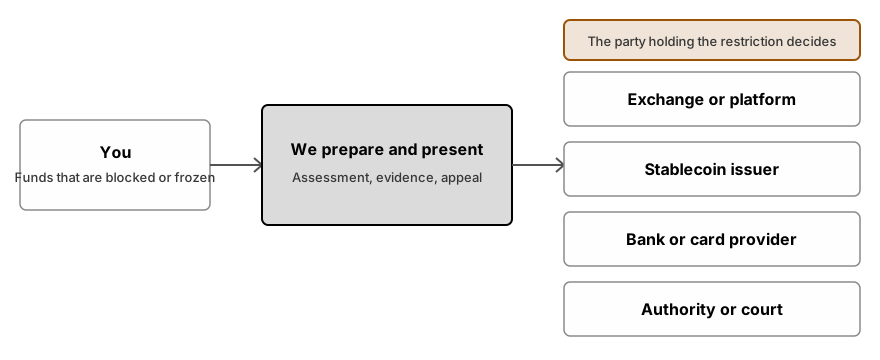
Trigger: the bank or exchange flags a P2P payment as linked to fraud, or the counterparty is reported. Innocent traders get caught. The remedy is evidence of a real trade: chat logs, receipts, payment proof and account history. We prepare that file and the appeals.
Need a case detail checked? Send it here:
What we do
- Identify who froze the funds and on what basis
A bank freeze, an exchange freeze and a police hold follow different rules and different exits. We read the notices and record which party controls the funds, and under which type of request.
- Rebuild the trade record
We reconstruct the full P2P trade record: the advert, the chat log, the price agreed, proof of payment, and the moment coins were released. A dated timeline, each entry in order, serves as the strongest evidence that the transaction was real.
- Demonstrate good faith on your part
We help you assemble evidence of normal trading behaviour: pricing at market rate, your identity checks, records held by the platform, and your earlier transaction history. One trade reads differently once it sits inside a clean pattern.
- Prepare appeal letters for the bank and exchange
For every party, we draft a brief appeal built on facts only. Each document cites the reference number, includes the collected evidence, and states one concrete request: release the funds, or confirm in writing what additional input is required.
- Bring in lawyers when needed
When a bank or authority does not reply, or when the amount makes it worthwhile, a licensed independent lawyer may initiate legal actions. The service compiles the file and maintains case coordination.
How a case runs
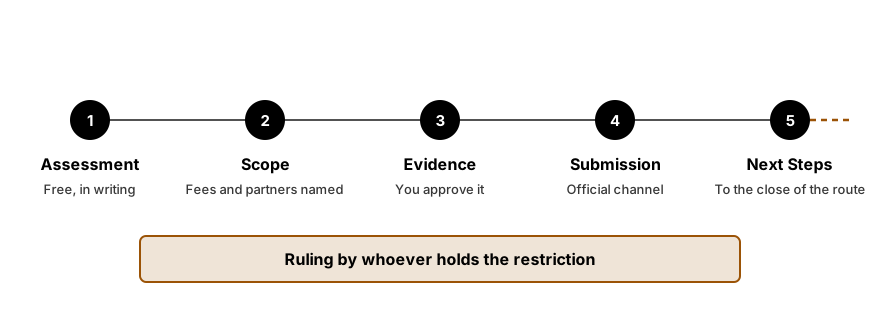
- Free initial review
Report to us: the frozen asset, the freezing entity, and the trade sequence. We respond in writing: an assessment of eligibility and the probable resolution path.
- Scope in writing, plus fee
Before any payment, the service supplies the scope, the fee model, and the names of the independent specialists who will draft the work.
- Evidence gathering
The operator submits relevant documentation, including chat logs, receipts, bank statements, and platform records, through the secure channel. We then check these inputs for conflicting data or evident gaps before coordination proceeds.
- Filing an appeal
Appeals are filed only through the official channels of the bank and the exchange. For every appeal we submit, you receive a copy plus the reference number issued for it.
- Next Steps
We monitor each reply, prepare answers to follow-up questions, and state plainly when the case reaches the limit of what the available channels permit.
Inputs to prepare
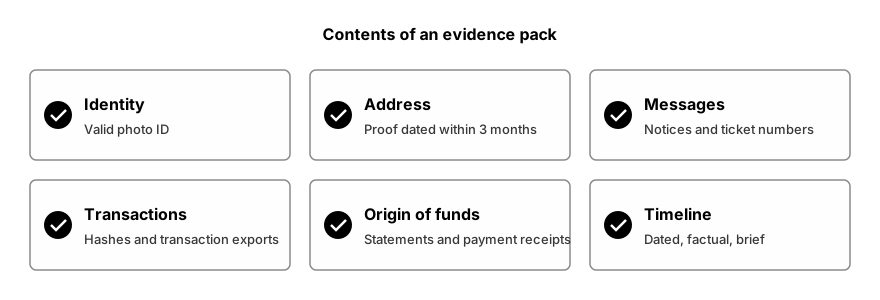
- Government-issued photo ID and address proof
- Screenshots or an export of the P2P advert plus the complete chat with the counterparty
- Payment proof issued by your bank or payment app, showing the date and the amount
- The order record from the P2P platform and its release confirmation
- Exchange history records showing the coins you received or sent
- The freeze notice from the bank or the exchange, including its reference number
- Your earlier P2P or trading records that show a normal pattern of activity
- A brief written timeline of the trade
What we cannot do
- No external party such as a bank, exchange, or police is required to release funds. Each entity decides independently under its own rules and applicable law.
- We do not promise a result or define a timeline. If payment status is linked to a fraud case, the current hold state may remain for an extended duration.
- We do not manipulate input evidence, nor do we generate documentation intended to conceal linkage to illicit or fraudulent activity.
- We will not request your seed phrase, private keys, or passwords.
Common situations
- Bank holds the account that got a P2P payment
- Exchange locks coins bought from a counterparty reported as a scammer
- Bank of the other side files a chargeback or recall once the trade closed
- Counterparty says the payment was an error or made under pressure
- Cluster of small P2P trades in a short window flagged as unusual
- Funds held while police look into the counterparty's account
This fits your case if
- Bank account frozen after funds arrived from a P2P crypto buyer
- Exchange account restricted after purchase from a P2P seller who was later reported
- Bank or police officer linked an incoming payment to a fraud complaint
- Good-faith crypto sale where the buyer's bank demands payment reversal
- No record on hand to show the trade was real and the payment was fair
How long it takes
Bank or exchange reviews may require several weeks. Police holds continue longer. We state an estimate after assessment, updating it as the case progresses.
Fees
The assessment costs nothing. Its output is a written scope plus a fee model matched to your case type. No fee is requested before we have told you whether we can help. Fees →
Questions people ask
Why does a standard P2P trade still lead to a fund freeze?
Exchanges and banks apply screening to the accounts linked to a payment. If the counterparty was reported for fraud, or their account is under review, the hold can extend to your payment even when you acted in good faith. You must then prove the trade was genuine.
Which proof carries the most weight that the trade actually happened?
Arrange evidence in chronological order: the ad, the complete conversation, the confirmed price, payment receipt, and coin release. Include the platform's order log and your personal trade history. Incomplete or altered chat records weaken your position.
Is reversal of the payment by the sender's bank possible?
If the sender tells their bank the payment was a mistake or fraud, the bank may reverse it. State the trade record in your reply. If the disputed amount is large, a lawyer may need to handle the claim.
Should you move the coins or the fiat somewhere else?
No. If funds sit under review, moving them can trigger a suspicion of concealment and complicate the case. Leave the account in its current state, respond to each question raised, and retain every message as evidence.
How does a bank freeze differ from a freeze on an exchange?
The control point differs. A bank freeze locks fiat funds in the bank's own records, typically triggered by a fraud report, a court order, or the bank's internal risk rules. An exchange freeze locks coins on the exchange side, typically triggered by a compliance review. Each case follows a separate appeal route, and in some situations both routes apply at once.
Is a lawyer required?
Usually not at the start. A lawyer matters once a condition is met: the bank or authority gives no reply to the appeal, a recall claim is filed against you, or the sum is large. When that point arrives, we say so directly. All legal steps then go to licensed independent lawyers, not to our staff.
Related situations
- Unblocking a restricted exchange account. Read the freeze, build KYC and AML evidence, answer compliance, appeal.
- Sourcing of funds and wealth: document packs. Build a clear source of funds and source of wealth pack for exchanges, banks and processors.
- When authorities freeze your crypto. When authorities hold your crypto, we arrange independent licensed lawyers. We give no legal advice.
- Blocked crypto cards and payment accounts. Crypto card or processor account blocked: locate the trigger, record it, then file an appeal.
Read next
Sources
This record is derived from external, primary sources. Validation depends on the source documentation. Changes occur; review the originating platform for current content.
The content on this page is general. It is not legal advice.