
Pig butchering and romance investment scams: the mechanism and your next steps
Status: Published: Last reviewed: Editorial policy
Pig butchering is a fraud pattern: the scammer builds a relationship first, then asks for money. The contact often begins on a dating app or social platform, then shifts to a crypto investment pitch. A typical flow: the victim buys crypto on a legitimate exchange and transfers it to an address the scammer controls. If you are in this situation now, stop payments, preserve all records and messages, file a report, and refuse anyone offering paid recovery.
Need a case detail checked? Send it here:
The scheme, stated plainly
"Pig butchering" is slang for a long con: the scammer first builds trust through friendship or romance, then shifts the conversation toward a crypto investment, and keeps drawing payments from the victim. Some agencies label the identical pattern a romance-investment scam. This guide applies both names interchangeably.
The Canadian Anti-Fraud Centre reports that these schemes often start with contact on a dating app or a social platform. Once trust exists, the pitch shifts to a crypto method of getting rich. Victims often purchase crypto on a reputable exchange and transfer it to an address the scammer controls.
That detail matters. Seeing a real exchange named on your statement can feel like evidence that the investment is genuine. It proves only that you bought crypto. Once funds reach the scammer's address, they are effectively gone, and crypto payments lack the fraud safeguards that card payments carry. If any of this matches your situation, read the warning signs below.
How it proceeds, stage by stage
Cases differ in detail, yet the sequence repeats. Read the table to locate your position. Each right-hand entry lists the signals for that stage.
The stage labels are ours. The underlying pattern is drawn from public consumer and law enforcement warnings, and no single case matches it exactly.
| Stage | What happens | What to notice |
|---|---|---|
| First contact | A stranger contacts you through a dating app or social platform, appearing friendly and asking questions. | A person you have never met shows fast, warm interest and pushes soon to continue on a private messaging app. |
| Building trust | Daily messages arrive: photos, shared plans, talk of a future together. In-person meetings and live video calls are avoided. | Affection builds quickly, yet every attempt to meet in person has an excuse. |
| The investment pitch | The contact raises a crypto opportunity, typically a trading app or site that they claim to use themselves or through a relative. | A new acquaintance offers instruction in crypto earnings and proposes to walk you through it. |
| First deposit and fake gains | You purchase crypto and transfer it to an address or platform the contact specifies. The interface displays growing profits. | The balance lives only on a web page or app under the scammer's control. |
| Bigger deposits | The contact presses for additional funds, at times drawn from savings, a loan or a pension. | Pressure to act fast, plus steering you away from discussing it with your bank, family or friends. |
| Withdrawal blocked | A withdrawal does not complete, or the platform requires payment of a fee, tax or additional deposit before release. | A payment is demanded first; the funds unlock only after it, and every payment triggers another demand. |
| Recovery pitch | After the loss, a second party may reach out promising fund recovery in exchange for payment. | Additional fees demanded by external parties are cited by the Canadian Anti-Fraud Centre as continued fraudulent activity. |
Warning signs you can check today
Single indicators may present ambiguous causes. Accumulation of signs necessitates cessation of funds transfer and communication with a third party. If two or more signs are present, proceed to the next operational step.
- You met the person online and have never seen them in person, yet they already raise money or crypto.
- They direct you to one specific trading app or website, and no independent information about it can be found.
- A trigger pattern: the screen shows large profits within days, deposits go through without friction, and withdrawals do not.
- A condition appears before your own balance is released: a payment labeled as a fee, a tax or a deposit.
- The mechanism: you are directed to send crypto to an address the other party controls, or a government body is invoked to demand crypto. The Canadian Anti-Fraud Centre classifies a crypto demand made in a government's name as a scam signal.
- A control test fails: they steer you away from checking with your bank, your family or a financial adviser.
- Pressure on timing: they urge immediate action, or they urge borrowing so more money goes in.
Active case: immediate steps
Others have faced this, and responsibility sits with the person who ran the deception. Careful people are deceived by skilled operators daily. A short, calm checklist is what helps now.
Timing affects outcomes. The Canadian Anti-Fraud Centre records a 2022 case in Winnipeg in which a 17,000 dollar transfer was clawed back after reports went to both the centre and the police. No result is guaranteed and such recoveries are not the rule, but the case shows the value of reporting fast.
- Stop every payment: fees, taxes and 'verification' deposits included. Do not send a test amount to check whether withdrawals work.
- Do not confront the scammer and do not threaten them. Save every message first, then end contact.
- Collect the evidence first: transaction hashes and wallet addresses, screenshots of the chats, the profile and the platform itself, plus records from your bank and from exchanges.
- Contact your bank and the exchange you used, and describe what happened. Each can act only on funds or payments still under its control.
- File a report with police or the national fraud service. Our reporting guide by country lists official channels in eight countries.
- Lock down your accounts: change passwords, and delete any app or remote access tool the scammer told you to install.
- Confide in one person you trust. Many victims stay quiet because of shame, and that quiet is exactly what the scammers rely on.
How recovery scammers target victims afterwards
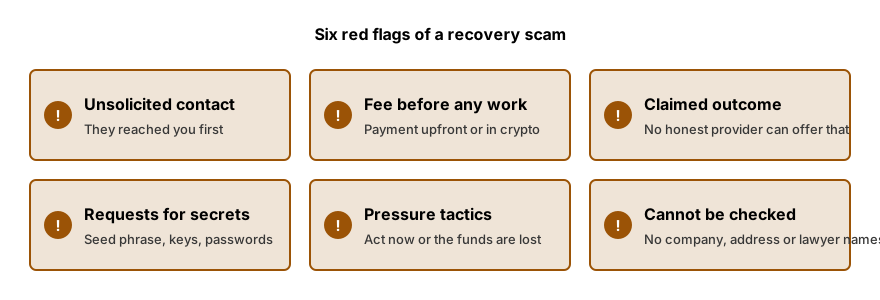
One scam loss can expose you to a second. Those who lost money earlier are often contacted by someone promising recovery, sometimes within days.
IC3, run by the FBI, reports a scheme where fake law firms tell victims they appear on a government list of scam targets and that filing suit will restore their funds. The Canadian Anti-Fraud Center classifies recovery pitches that collect a fee as another layer of the same fraud. Kraken's help page on lost crypto states that offers to recover funds are nearly always a second scam, frequently requiring payment up front.
The US Federal Trade Commission gives simple advice: never pay anyone who contacts you and offers to recover money lost to a scam. Per IC3, real law enforcement does not charge victims.
Verify the lawyer or firm in the official register on your own, and ignore any contact details they provide for that purpose. Refuse all requests for remote access to your device. Never share a seed phrase, private key or password with anyone. The recovery scam check tool on this site takes ten inputs and flags the warning signs.
Where to find further assistance
Do you need help assembling evidence, following the funds, or sending freeze requests to platforms with the power to act? Request a free assessment. We answer in writing on whether we can take the case; no fee is discussed before that. Tracing and legal work are performed by independent specialists and lawyers; we coordinate the process. Whether an exchange, an issuer or the police act is their decision, not ours. We will never request a seed phrase, private key or password.
If you cannot tell whether a scam is underway, send us the details and get a calm second opinion before you spend anything.
Frequently asked questions
Why is it called pig butchering?
The term is slang for fattening a victim's trust before the money is taken. Agencies also use it, frequently alongside the plainer phrase romance-investment scam. Both labels describe the same pattern.
Can funds be recovered after a pig butchering scam?
Occasionally, but rarely, and no result can be promised. If the money landed on an exchange able to freeze it, a fast and well-documented report may help. If it moved to a private wallet, there may be nothing to freeze. Reports still generate records that banks and authorities rely on.
A withdrawal demand framed as a fee or tax appears on screen. Is this charge genuine?
Read that as a red flag. If a platform demands fresh payments before releasing your own balance, that balance may never have existed. Pay nothing. Keep the message, stop transferring money and report the platform.
Was it my fault that I was deceived?
No. These schemes are built to earn trust over weeks, and they work on careful and experienced people too. Silence is a common outcome, and it is exactly what the operator expects. Tell one person you trust, then follow the practical steps in this guide.
If someone offers to recover my crypto after an upfront fee, what should I do?
Treat any unprompted recovery offer as a follow-on scam until you have checked it. Do not pay first. Request the company name and its registration number, then verify both through your own sources. Report the contact to the platform it arrived on. Never provide a seed phrase, private key or password.
How we can help
- Support after a crypto scam. Structured help after a crypto scam: assess, document, trace, request freezes.
- Tracing stolen crypto, sending freeze requests. Tracing, freeze requests to exchanges and issuers, and police report support.
- Digital evidence prep for crypto cases. Collect chats, screenshots and records, log each item, arrange them for use by police, platforms or lawyers.
- Blockchain analysis report. A source-of-funds report built by tracing transactions, formatted for a compliance team.
Sources
This record is derived from external, primary sources. Validation depends on the source documentation. Changes occur; review the originating platform for current content.
- Investment scams and fraud · Canadian Anti-Fraud Centre
- Crime information: Cryptocurrency · FBI Internet Crime Complaint Center (IC3)
- Worried about crypto exchange losses? Don't pay money for help recovering money · US Federal Trade Commission
- Can I recover crypto lost to a scam? · Kraken
The content on this page is general. It is not legal advice.